Changes in Rumen Fermentation Using a Polyclonal Antibody Preparation in Heifers

ABSTRACT: Physiological changes in rumen fermentation during acidosis induction and its control using a multivalent polyclonal antibody preparation (PAP) were studied in a completely randomized experiment using 12 crossbred heifers (452 ± 20 kg of BW). Treatments were control (CTR) or PAP. The acidosis induction protocol consisted of 3 periods: 3 mo of 100% fescue hay fed for ad libitum intake, 10 d (from d 1 to 10 of the experiment) of adaptation to the treatment (100% forage feeding + 10 mL/d of PAP top-dressed to the treatment group), and 5 d (from d 11 to 15 of the experiment) of transition, which consisted of increasing the concentrate (16.5% CP) 2.5 kg/d up to 12.5 kg/d while maintaining ad libitum intake of fescue and providing 10 mL/d of PAP to the treated heifers. Concentrate feeding of 12.5 kg/d was maintained until heifers developed acidosis (from d 16 to 22 of the experiment). When an animal was considered acidotic, it was changed to a 50:50 forage:concentrate diet, monitored for 4 d, and removed from the experiment. Samples of ruminal fluid were collected before and 6 h after feeding to determine pH, VFA, lactate, protozoa counts, and DNA extraction for quantitative real-time PCR and denaturing gradient gel electrophoresis analyses. Only samples
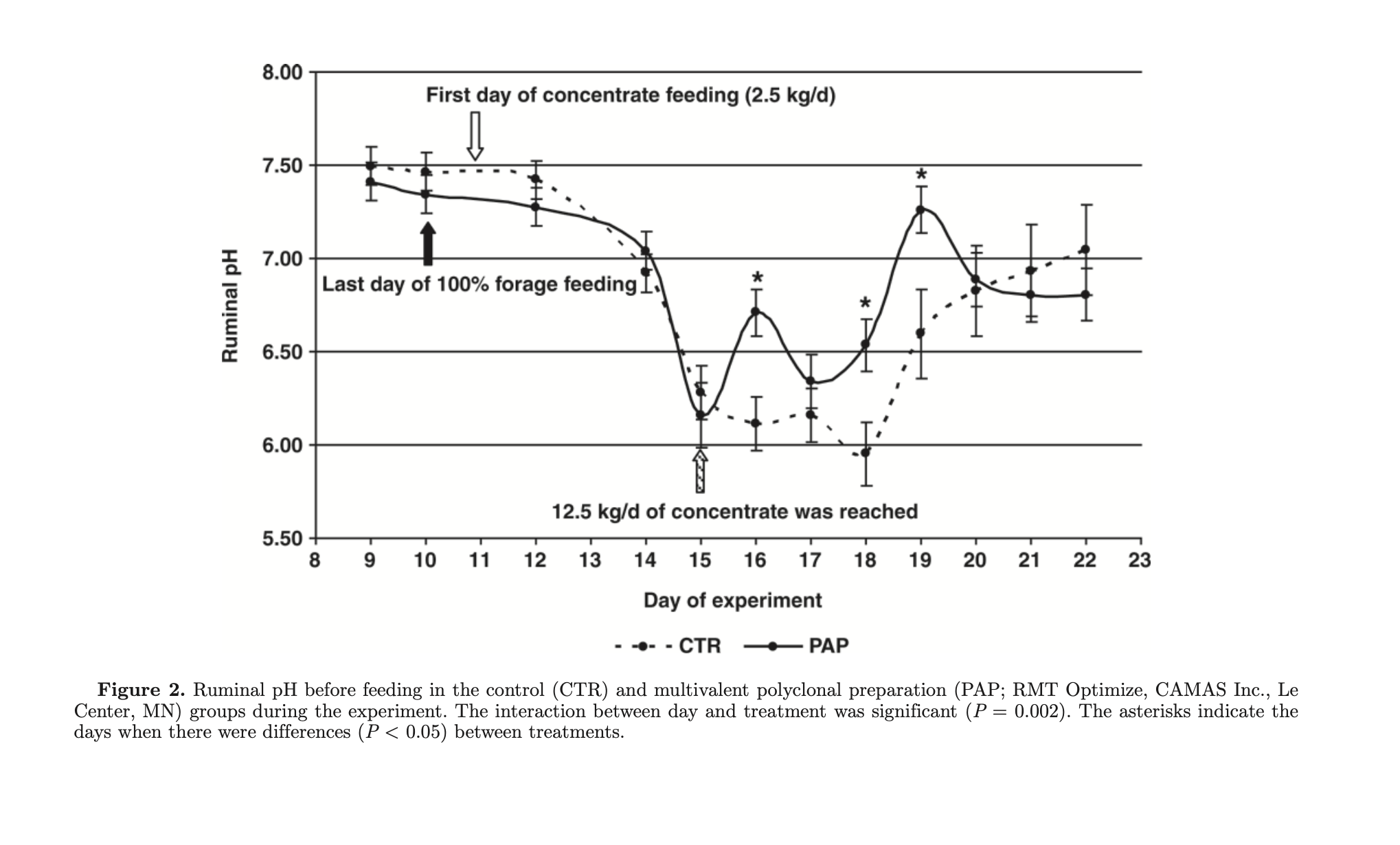
collected during adaptation to the treatment, at 3 and 1 d before acidosis, on the acidosis day, and at 1 and 4 d after acidosis were analyzed. Differences were declared at P < 0.05. Heifers (83% for CTR, and 50% for PAP) entered into acidosis 5.25 ± 0.17 d after the beginning of the transition. The fermentation profile of animals with acidosis was similar between treatments. From 3 d before acidosis to acidosis day, decreases in pH and in acetate-to-propionate ratio and increases in total VFA, butyrate, and entodiniomorph counts were observed. However, the greatest concentrations of Streptococcus bovis and Megasphaera elsdenii (79 ± 54 and 104 ± 73 ng of DNA/mL of ruminal fluid, respectively) and a decrease in DMI (10.6 vs. 6.46 kg, respectively) were recorded 1 d after acidosis. Compared with CTR heifers, heifers fed PAP had greater pH before feeding on d 6 (6.70 vs. 6.11), 8 (6.54 vs. 5.95), and 9 (7.26 vs. 6.59) after the beginning of the feeding challenge. Heifers fed PAP tended to have greater total VFA concentrations than CTR (124 and 114 ± 4.0 mM, respectively). These results indicate that PAP may be effective in controlling acidosis of heifers during a rapid transition to a high-concentrate diet.
Download the full PDF here - Blanch et al 2009 Physiological changes in rumen fermentation